
New filter shows promise in treating Mar-Kit landfill leachate
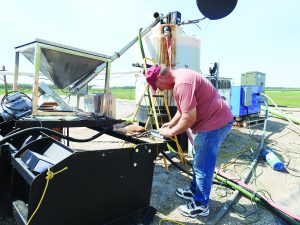
BRIAN BARTEL, president of USA Sludge, works on a timing system to make new leachate treatment system run 24/7 at the Mar-Kit Landfill east of Hallock.
(Enterprise photo by Anna Jauhola)
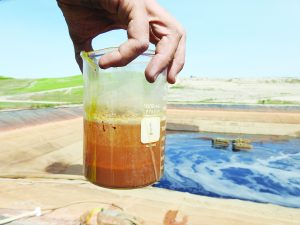
THIS TREATED LEACHATE is an example of how the new filtering system is working to separate chemicals from the water.
(Enterprise photo
by Anna Jauhola)
By Anna Jauhola
In the last 30 years, Mar-Kit Landfill has led the way in improving how this type of facility operates in Minnesota. Yet again, landfill staff and board members have made the decision to be the first in the state to make its leachate safer by implementing a biological breakdown system.
“I’ve been trying to find a solution to our leachate for a long time,” said Dale Nelson, Mar-Kit Landfill manager. “It’s the last piece of the puzzle to what we do.”
Leachate is the water that filters through the trash, into the ponds and is aerated as the form of treatment. While other landfills recirculate the leachate on the premise that it breaks down the garbage more, Nelson said Mar-Kit just collects it in ponds for treatment and irrigation. That’s not working anymore as the leachate has become more potent. Over the years, it’s become apparent the leachate is causing issues in the soil, so they needed to find a solution.
“A lot of facilities haul it to another place, like Grafton or Drayton. We’ve done all the numbers on that and I’ve always felt that we need to be able to do it onsite,” Nelson said.
That’s where USA Sludge comes in, a company out of Arizona that specializes in separating the sludge from leachate to break down the chemicals. Nelson has been working with Brian Bartel, president of the company, to set up a filtration system at the landfill, for a four-month trial project.
They initially set up operations in May with the filtering system running only during landfill operational hours. However, Bartel visited on Friday, Aug. 2 to install a timing system to ensure the filter runs 24 hours a day.
“This is a mineral process where we need to mix this flocculant, BioClean, and the NoPhos, a rare-earth mineral chloride, and ferric,” Bartel said. “When you combine those together, you create an electro-connection in the water that will drop the solids out of the water and break the compounds apart, and float the clean water to the top.”
He said Mar-Kit has a lot of hydrocarbons in the leachate, which will get trapped in the sludge that forms when this process takes place. The timer will circulate the system for 15 minutes and then allow it to settle for 15 minutes. Once they can collect the sludge from the ponds, it will be superheated in another container where it will gas off into a carbon filter.
They also use a biological fermenter, where they add advanced biology to consume biological elements of the pre-treated leachate including organics that have chlorine and carbons attached.
“So if we get really, really lucky – I’m saying that, because we haven’t gone to the extreme where we’re getting it yet – but we think we’ll be able to consume a significant part of this sludge,” Bartel said.
Bartel’s company is partnering with Premier Materials out of St. Paul, which produces a machine called the EcoSOAR, the filter used in the process. Nelson met both Keith Boulais, CEO of Premier Materials, and Bartel at a training conference in Bemidji earlier this spring. They did a presentation at another meeting in St. Cloud, which convinced Nelson their solution could work for Mar-Kit, so they visited the landfill.
With approval from the Mar-Kit board, they are spending $15,000 per month for this trial project.
Bartel said the leachate at Mar-Kit “seems to be the nastiest stuff we’ve ever seen.” In lab testing, the leachate etched a mark around a glass beaker.
“That’s how strong it is. And I don’t know why,” Bartel said, noting he’s worked with many leachates at landfills across the country. “The point is, if we can get it taken care of here, we can probably get it taken care of anywhere.”
Currently, the filtration system is set up on the ridge between the two wastewater ponds on the south side of the landfill. Should the trial project work as well as they hope, the next step would be to erect a building to house the system and run it year round. By doing the trial, Nelson and Bartel will be able to gather enough data to figure a final cost of operating this system full-time. A cost, of course, will enable Nelson to negotiate future contracts with cities that haul waste to the landfill.
Nelson is really excited and optimistic about this system working well to create a safer environment around the landfill. With garbage hauled in from as far away as Koochiching County in Minnesota and Devils Lake in North Dakota, safety has always been a cornerstone of how the landfill operates. Nelson has managed the landfill since 1993, and he implemented leachate sampling.
“We’ve actually sampled the longest for any landfill in the state for PFASes in our wells – about 11 or 12 years,” Nelson said. “The irrigation has been tried and true for 31 years, but it’s not the long-term solution. Irrigation would be a long-term solution if we could get the water cleaned up immensely.”
Nelson is hopeful the filtering system will do just that and not at a great expense. He said the Mar-Kit board has always been willing to try new things to make operations safer and more efficient, for which he is grateful. He said this project will likely be the last piece in his puzzle of work at the landfill. He hopes it’s successful and the legacy he leaves when he retires in a few years.


