
Exciting results coming from study of lakebed
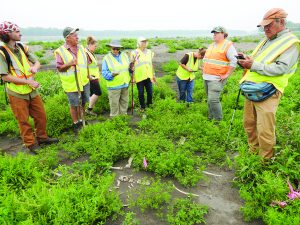
MINNESOTA STATE HISTORICAL SOCIETY ARCHAEOLOGISTS and volunteers discuss a string of bones (bottom of photo) the group found on Wednesday, July 23. Those who have helped with the study have found several amazing artifacts.
(Enterprise photo by Anna Jauhola)
By Anna Jauhola
Since state archaeologists started a study of the Lake Bronson basin, they and their volunteers have flagged hundreds of interesting finds. From flint knappings to bison bones, and many items in between, the study has been very successful and informative so far.
At the end of June, volunteers began assisting the Minnesota Historical Society with a pedestrian survey. Walking the lake bed with Jennifer Rankin, archaeology director from MHS, and others, those volunteers have found items significant to pre-contact civilization such as flaking debris and bison bones, as well as glass bottles and fishing lures from the early days of the lake.
“There are at least five archaeological sites so far,” Rankin said. “And we’re debating whether this is just one big site or maybe two big sites.”
In one location, on several rises across the basin, volunteers have flagged sites that indicate bison kill and processing locations, as well as tool manufacturing locations by pre-contact indigenous people.
“There’s clear evidence of that,” Rankin said.
As they get closer to the Bronson Farmstead, which is visible she said, they have found evidence of both bison and cow bones. So, they are trying to find photos that show more of the farmstead to indicate the types of animals they kept, but also the number of buildings.
“We’re seeing a lot more foundations than we anticipated based on historic photographs,” Rankin said. “We want to know if there were any food storage, ice houses and other outbuildings that existed.”
She sent a team to the National Archives in Maryland to scour for documentation of the dam project as well. There could be more photos of the Bronson Farmstead there, as well as the WPA camp and the whole project.
Another interesting feature of the study is the tree stumps left behind when WPA workers clear cut trees for the dam project. Rankin said the workers not only cut the trees to make a clear lake, but also to use for building structures at the WPA camps, and for use in the dam construction.
“What’s really cool about the tree stumps is, depending on when they were cut, they basically are like a moment frozen in time,” Rankin said.
Unlike stumps left to rot on a forest floor, these stumps have been preserved in the lake. This allows archaeologists to perform ring dating, take core samples and determine fire history for the region, along with climate history like wet and dry seasons.
She noted in their survey of the WPA camp area near the dam, they have found the power house, bath house and latrines. They are excavating around the power house and due to the water’s preservation, the original wood siding of that building is still attached and one log post still has its original bark.
“That never happens. In archaeology, we never see that kind of thing where the wood is preserved,” she said.
Because this location is right next to the dam construction, MHS will not allow people in that area for tours.
Ancient artifacts are mixed in with more recent ones throughout the basin. While many lures of varying ages have been flagged, along with beer cans and bottles, sunglasses and other items, Rankin is excited about figuring out exactly why ancient peoples came to this basin repeatedly. She said this was first evidenced during the excavation of the burial mounds across County Road 10 during the 1930s. It’s been clear that early people followed rivers, and that first excavation showed that people came all the way from central North Dakota because 30% of the stone found here is Knife River flint.
“You have to then ask the question of, ‘Where’s the other 70% of material coming from?’” she said. Most of the flakes they’re finding are chert, a stone associated with glacial Lake Agassiz and often found along the North Shore of Minnesota.
More than likely, as the glacier Agassiz receded, it left deposits of rock along its glacial lake shorelines. She said they have definitely identified an area where pre-contact indigenous people were processing bison and a separate area where they were just doing flint knapping. Rankin hopes in further excavation they might find remnants of structures below the surface.
“We’re seeing the spatial organization, which is what you want to see in an archaeological site,” she said. “There are a lot out there, but the most important ones are the ones where we can tell … they are specifically associated with something like stone tools or a site specifically set up for coring stone tools.”
The spatial organization also points to dense occupations within the area, which correlates with the 1930s study that early people repeatedly visited the basin.
Any artifacts, but particularly the bison bones and stone materials they gather, will be studied in the MHS lab over the winter months. That data collected will help determine a good timeline and whether the sites discovered in this study are new sites, or extensions of previous sites.
This project has a limited timeline, considering it will depend on how the dam reconstruction progresses. The study will likely not extend into 2026, which is OK. Rankin said she and her team are already worried about erosion and the elements affecting artifacts. The banks are especially susceptible to elemental and people-caused erosion, particularly during the winter months. The team plans to finish removing artifacts in September – a painstaking process as they have to cross-check and mark all artifacts with GPS data.
After all artifacts are processed and studied, Rankin said many will be returned to Kittson County for display at the museum in Lake Bronson and display at the state park.
“There’s enough material to accommodate both those groups, or any other requests,” she said. “We’re always trying to think of unique ways of how to get archaeology special collections integrated.”
This weekend, the public will have a chance to tour one of the archaeological sites as a special part of Bronsonfest. Those interested can meet archaeologists at the swimming beach in Lake Bronson State Park. This area provides the most accessible walking tour where the groups will access a landform on the lakebed that contains a concentration of bison bones.
During the tours, participants will have the chance to handle different artifacts provided by the team to better understand what is being found.
“And there’s always the potential we might find something while we’re out there too!” Rankin said.
From that landform, tourists will have a good outlook of the basin itself. Unfortunately, tours will not extend to the Bronson Farmstead. Rankin said they have been brainstorming how to make it accessible as they’ve been getting requests to visit the site.
“The Bronson Farmstead is actually a hike. It is actually hard to get out there with a group safely,” she said.
Until they figure out a safe route, the swimming beach area tours are available. Anyone can go, even kids as there are not many tripping hazards. But people should be aware that tall plants are growing on the lakebed and there is a depression to walk through. The one-hour tours will take place Saturday, Aug. 2 at 9 a.m., 11 a.m., 1 p.m. and 3 p.m. A park vehicle permit is required. Those attending should dress appropriately as the lake bed can be muddy.
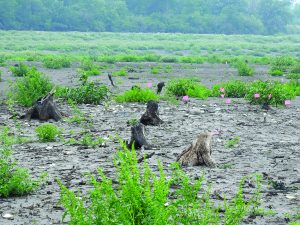
THESE ARE EXAMPLES OF STUMPS that were clearcut in preparation for filling the lake in the 1930s. These can tell archaeologists a lot about environmental patterns.
(Enterprise photo by Anna Jauhola)
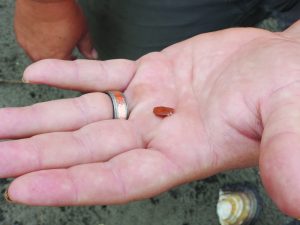
THIS CHIP OF RED STONE was cut from a larger stone by a pre-contact indigenous person. The red color indicates the bigger stone was first heated up before it was worked on.
(Enterprise photo by Anna Jauhola)
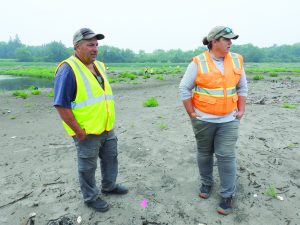
JENNIFER RANKIN, MHS archaeology director on right, visits with local volunteer SCOTT BILLINGS. Rankin said most of the volunteers have been local, but some have come from all over Minnesota and North Dakota.
(Enterprise photo by Anna Jauhola)
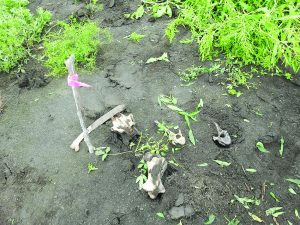
VOLUNTEERS FOUND THIS PILE OF BONES in line with several others. It is possible these bones were washed up as the lake was drawn down. The bones will be analyized in a laboratory over the winter with the other artifacts found to officially determine their species.
(Enterprise photo by Anna Jauhola)


Will there be any tours in late Sept
Contact Lake Bronson State Park at 218-754-2200 – they will be able to let you know.