
Leading a paradigm shift in healthcare
By Anna Jauhola
Kittson Central students have an opportunity to help healthcare workers in the region better cope with the stresses of their jobs. The Media Arts class filmed interviews with local and regional healthcare workers, conducted by Tim Denney, mental health lead for the Northwest Health Services Coalition, on Tuesday, Sept. 23.
“We’re the only coalition in the state that has an active behavioral health program,” Denney said. “We’re trying to help them build a more robust workforce. The work they do, particularly in Emergency, is very difficult and can be very trauma-inducing and emotionally exhausting.”
He noted that during the COVID-19 Pandemic, in Minnesota alone 800 nurses changed professions because of the burnout and stress. Denney’s mission through the coalition is to determine how they can help medical professionals become stronger, more resilient, than they already are.
“We want to help them build what we call a culture of recovery, where we build resilience and well-being and recovery practices into the everyday activities of the unit, ” Denney said.
During interviews with three local healthcare professionals, debriefing came up multiple times. They all noted debriefing after a traumatic event is important to allow everyone to process everything that happened. They added it’s not just about discussing whether they did everything right, it’s talking about how each person is handling the after-effects as well.
“It’s kind of a ‘how’s your heart’ question,” Denney said. “And then we have things built in that bring encouragement that help people build strength, that help them think positively. Positivity also came up several times this morning.”
Sending a thank you note is great, but facilitating employees’ overall well-being daily by providing support and resources is just as important.
The students filming the professionals’ responses to Denney’s questions were visibly affected by some of the stories they shared, and how those professionals handled the events. Markelle Kuznia, a registered nurse at Kittson Healthcare, mostly works in the emergency room. In her 12 years as a nurse, Kuznia said the emotions, visuals and trauma are seared on her brain after particularly bad incidents. One of the worst she experienced was a teenage burn victim. She said the screaming and agony from not only the patient, but also the parents, was haunting.
“But you learn from it, move on and help the next person. You put it in a folder,” Kuznia said in the interview.
These types of patients are why Kuznia thoroughly believes in debriefing, because it allows her to talk through the incident. It allows her to feel the emotions, remember the incident but also to move on.
Kathy Phelps, director of radiology services, also identified debriefing as important to an overall healthy team of professionals. She emphasized the need to include everyone who was involved in an incident, no matter the level of involvement. She said oftentimes, the radiology department takes pictures and then assists in any way possible during traumatic events. But that doesn’t mean that event doesn’t affect them.
She told the story of having to X-ray a deceased child, and how debriefing after that helped her deal with the stress.
No matter the position, healthcare professionals have to remain calm and focused during patient treatment. Kuznia and Phelps both agreed, they will release their emotions afterward and find a way to handle it through self-care and leaning on fellow professionals.
The Media Arts class will now take these interviews and review them for the sound bytes needed to produce a video used in facilities to help them evaluate how they can improve the culture.
“It’s going to be a different way of thinking,” Denney said. “It’s going to be a new paradigm because now we’re going to look at our team members from the standpoint of resilience and well-being, not just skills. They are equally important. It’s a system change.”
He emphasized, this is not a training exercise. It is a change in how entities think about their employees and how they interact around the difficulties of their jobs.
“We want that paradigm shift to lead to practice changes that are embedded – not something we dust off when things go really bad,” Denney said. “Something we do every day.”
He said Kuznia and Phelps were really “poster children” for the purpose of this project because they understand the need to think differently. He said long-term survivors in jobs like this have learned different ways of thinking and how to handle the stressors, because they’re still in the field.
Tina Turn, Media Arts teacher, said the draw to work with Denney on this project was the real-world aspect of recording the interviews and then re-watching them during the editing process. She added she could see the impact and how the students’ faces changed as the interviewees’ told their stories.
“I asked them to pay attention to who was saying what, because there’ll be a lot of going through those videos to try to find what they said,” Turn said.
The class will produce the entire video, with Denney’s input. Turn admits it is a huge project they’ve never done before, but she’s confident her students can figure out the new programs they’ll use.
“You know how teenagers are, they’re quicker with technology anyway,” Turn said. “We’ll figure it out together and we’ve got Tim as a resource, and he’ll guide us for what he needs. I think it’s going to be a good real-world experience for them all the way around.”
Denney said this video will be shown at healthcare facilities across the 14-county area covered by the Northwest Health Services Coalition, with the potential to be used statewide.
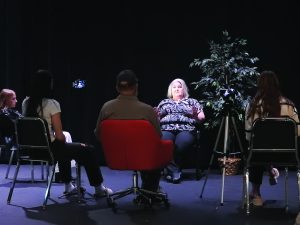
KATHY PHELPS, center, is interviewed by Tim Denney, in the red chair. Students, l-r, Kami Hanson, Kaydence White and Brynn Hennen. (Enterprise photo by Anna Jauhola)
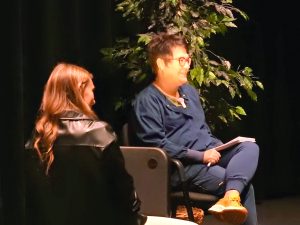
MARKELLE KUZNIA, right, shares a laugh with students just before filming her interview on Tuesday, Sept. 23. Senior Kami Hanson, right, was one of the nine students working on the project. (Enterprise photo by Anna Jauhola)


