
Kittson County ‘Garden of Eden’ for crops this year
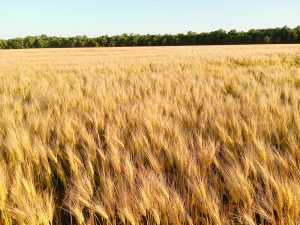
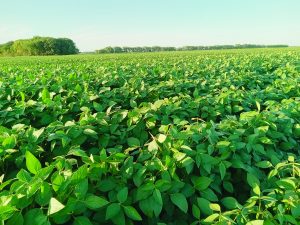
WHEAT AND SOYBEAN FIELDS are looking perfectly on time throughout Kittson County this year. Full heads of wheat and lushious, full soybean plants can be see across the area. (Enterprise photos by Anna Jauhola)
By Anna Jauhola
Despite a long string of rain during planting season, crops in Kittson County are in great condition and on track for a timely harvest. Wheat, soybeans, corn and sugar beets are all doing well across the county, with small exceptions where too much rain fell during certain periods.
“There were some pockets that didn’t get planted. We had 61 farms that had some prevent-plant acres on them, which in some respects kinda surprised me,” said Kittson County FSA Executive Director Nathan Johnson. “But when we compare to our neighboring counties, we’re in the Garden of Eden.”
A short drive around the county last week showed golden wheat, lush soybeans, huge sugar beets, drying canola and sky-high corn. This week, drivers will likely see combines expelling spring wheat chaff.
“I think in general, producers are pretty happy with what the wheat looks like,” Johnson said.
In April, producers of all crops were likely a little worried when rain seemed to delay planting and threatened to ruin crops already in the ground.
Many producers have already sprayed wheat with desiccant, that is a chemical that dries out the crop evenly to make harvest easier. Johnson said fields can sometimes harbor low-lying portions that didn’t mature as quickly as the rest of the field. To avoid harvesting pockets of green wheat, producers spray fields to ensure an easy, straight-through harvest.
Soybean producers are looking for good things from their crops too. They are hoping for timely rains and warmer temperatures between now and harvest in September, Johnson said. The weeks of temperatures in the 80s certainly moved the maturity along.
“The opportunity is there for a nice crop,” he added.
Sugar beets have a couple months left to go, but producers have said everything looks great and in line with maturity dates.
“They’re just as lush as everything else,” Johnson said.
Canola producers also seem to have a good crop on their hands.
“Everywhere you look is yellow! In the month of June, it was bright,” Johnson said.
In Kittson County, spring canola takes up 34,000 acres this year. Johnson said the crop went on the decline about six years ago, but has now made a resurgence across the county. Pricing is likely a factor in the upswing. It’s possible the change in how the crop is harvested – upright instead of swathing, drying and then combining – could also have a bearing on the increase in acres.
Corn is the surprising crop in the mix. While corn has always had a presence in the fields of Kittson County, its significance has changed. While corn was often chopped for silage years ago, and more recently grown for ethanol production, research and development has increased its ability to grow as a grain. Producers have planted just over 15,000 acres of corn this year in the county, Johnson said.
“The days of growing it for grain corn, if it didn’t make it, you chopped it, are kind of behind us,” Johnson said. “The idea we have the maturities to make it in northwest Minnesota, Kittson County, has changed. It got some producers that have invested in the idea of raising corn.”
While the destination of each grain corn crop varies, Johnson said the genetics and varieties have provided a tighter window of maturity to match up with Kittson County’s short growing season.
As for livestock producers in the county, the season has been just as productive. Alfalfa grew nicely, providing for a good first cutting and nice bales. The challenge was, again, the string of rain that plagued the area. When the rain was heavy to the east, this caused issues for producers to even get into alfalfa and grass pastures to do anything, Johnson said.
“Last year we had drought concerns, so they didn’t put up as much,” he added. “This spring turned that around. Pastures for livestock people have had lots of grass through the course of the summer.”
Continued on page 3B
Many have already had a second cutting, but perhaps had to wait a little longer because of the rain. They may have a third cutting before the summer’s through.
“All in all, with the inability to control the weather, I think it’s turned out alright this year,” Johnson said. “But as the producers say, it’s not in the bin.”


