
Dam project in motion
Contractor to mobilize by end of October
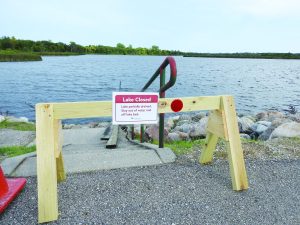
LAKE BRONSON is officially off limits as dam construction will begin soon. (Enterprise photo by Anna Jauhola)
By Anna Jauhola
Lake Bronson looks different after the Minnesota DNR dropped the water level 4 feet, and it’s about to look even more different when Ames Construction begins the dam replacement. At a meeting on Tuesday, Oct. 1, at the Visitors’ Center in Lake Bronson State Park, the DNR laid out the plan and approximate timeline for the $28.5 million project
About 40 people attended the meeting besides six DNR representatives.
Plans to replace the Lake Bronson Dam have been in the works for more than 10 years. The 2020 bonding bill provided $20 million to move the project forward. In 2023, the DNR secured another $4 million to further fund the project. That same year, Kittson County received a $2 million grant from the State Park Road Account to build the bridge and road above the new dam as the county owns those structures.
Ames Construction bid $28,492,398.28 for the project. The engineers estimated it would cost $25,665,478.
To cover the rest of the funds needed, the DNR secured money from its own Natural Resource Asset Preservation Funds.
“You may have noticed a 4-foot drawdown, so things look a little different,” said Jason Boyle, state dam safety engineer. “That was because we had some gate issues with opening and closing the gates. There were some things that needed to be fixed, but knowing shortly these gates are going to be demolished, and the spillway is going to be demolished, it didn’t make any sense to try to fix those.”
Boyle said the project started with design by Barr Engineering, a company that specializes in dams, along with sub consultants SRF and Freese & Nichols. The dam’s design is a labyrinth weir, which looks like a zig-zag from above, will improve flood control and not require park employees to dangerously operate gates during high water events.
“Now we have permits and reviews,” Boyle said. “The environmental review took about a year.”
The DNR has obtained its own waters permit, a Two Rivers Watershed permit, water quality certification permit from Minnesota Pollution Control Agency. They are awaiting final permits from the U.S. Army Corps of Engineers, which includes historic property reviews from the State Historic Preservation Office.
They are also awaiting final submittals from Ames Construction, such as its water control plan. Once that plan is in place, there will be better information on when the lake will be fully drawn down to the stream bed. Ames has a pre-construction meeting at the park on Tuesday, Oct. 15.
Stacy Smith, a development consultant for Parks and Trails, said the project requires a partial closure of CSAH 28 as that road will be rebuilt along with the bridge over the new dam.
“The contractor will start to mobilize equipment and staff and getting things set up in and around the park in the next several weeks,” Smith said. “As of right now, we’ve worked with the contractor to find out how this project will go. … It will be substantially complete by Dec. 1, 2026. The following summer, by July 2027, the final completion will include seeding, planting, cleaning the site up and getting it ready to be a park again.”
Construction area
and complete dam
The new dam will drastically change the current dam location, largely because the project requires 1.62 acres of old-growth forest to be removed. Cindy Lueth, regional resource supervisor for DNR, said through the process, they were able to work with the contractor to mitigate impacts.
“We had discussions on the outflow of the dam downstream where that old growth forest is – DNR values these and I am charged with protecting these,” Lueth said. “So when we mitigated it, we will have a loss of about 1.5 acres of old growth forest but the flip side is we avoided damaging or taking or reducing the old growth forest by another 2.5 acres. So we call that a success.”
She also noted her team has worked to ensure rare species aren’t impacted by the project, including the white lady’s slipper and a rare mussel found downstream.
While the lake and its tributary is a major migratory flyway for birds, Lueth said the lake has only existed since 1937, and not for 1,000 years. Birds will adjust and find other wetlands to use during their migration and when the lake is filled again, they will again alter their route.
When the area for the new dam is excavated, most of that fill will be used to close the old spillway, Boyle said. Whatever is left over will be hauled offsite by the contractor.
Members of the public asked several questions, including details about the dam itself, how it will work and how it will be constructed. The new dam will be much wider and have a two-lane bridge over top, plus a lane for the bike path. Cyclists and pedestrians will no longer have to use the bridge or the grated catwalk to cross the dam, Smith said.
The road will also be built higher than the current road.
“The way the consultants have designed this labyrinth weir is that we have a target that passes over the dam based on anticipated storm events we may see,” Smith said. “What we’ve done to allow a large amount of water to pass is we’ve had to raise the bridge higher. In order to get that bridge to the elevation we need, we have lengthened the bridge.”
The new dam’s design allows for twice the capacity within the spillway. The water will raise some during a flood, but not increase nearly to the point it does now. The weir zig-zag will also eliminate the need for manual operation. The new dam will also keep the lake at its typical level.
“The new channel is about 600 feet long and matches up with the old channel,” Boyle said. “So about 600 feet from the road downstream will be changed. It’ll come in before the first bend in the river.”
Lake Bronson Park Manager Tim Williamson shared his excitement about the project calling for a debris boom – a floating barrier that will catch logs and other debris to prevent them going into the dam. Currently, staff takes pontoon boats on the lake regularly to remove large logs before they get to the dam and block the spillway.
“I can’t tell you what a game changer that’s gonna be for our staff,” he said of the debris boom. “Rather than being out there in a snowstorm, with visibility from here to the wall, we’re going to be able to pick more safe moments and not put people in potential harm’s way to get things off the lake.”
When construction is complete, there will be one parking area with a walking path, ADA accessibility including a crossing and fishing pier, and historic interpretation signage. One person asked whether portions of the old dam could be saved and incorporated into a monument within the state park. DNR representatives said that’s an interesting idea. Williams said for sure the original bronze plaque from the dam’s 1937 dedication will be saved and placed within the historic interpretation.
Ben Bergey, regional manager for Parks and Trails, said the dam itself is too unsafe to save any part of it in place. It will be entirely removed.
“Leaving the dam in place is not in the best interests of visitors moving forward,” he said. “However, the history, every element of what makes this place is extremely important to us as well as all of you.”
Part of the permitting process includes historic interpretation, however that plan is not complete yet. Smith said elements of the current structure will be worked into the new bridge to remind residents of the structure – elements from the concrete design and the railings, for example.
Why the dam is needed
“Just two weeks ago when it rained that Monday night, dumped 5.5 inches in Greenbush,” Williamson said. “Amber (Locnikar) and I, at 10 p.m., were standing on the dam, she was showing a flashlight so I could adjust the gates. Thankfully the dam made it through. That’s the norm here.”
Lueth was on site during the October blizzard about five years ago, assisting park staff in monitoring the dam and adjusting the gates. They had to be out there every two hours to ensure it was flowing, checking known cracks, water bubbling up from the ground and reading gauges.
“That dam is incredibly dangerous,” Lueth said. “The danger is to the downstream community. That is what our park staff who live here have been dealing with for years and years.”
She acknowledged the years of efforts put in by park personnel to ensure the dam continued to operate as safely as possible. She noted the times she and her team have helped remove logs from the lake during high water events “so they don’t crash into that fragile dam and have a big log flow jammed up and there goes the dam.”
A member of the public asked about the cracks in the dam and whether the extent of those cracks was as bad as the DNR portrays.
“The current spillway has lots of concrete sprawling,” Boyle said. “The concrete is chipping off, you can see the rebar exposed to the elements. There was some cracking on one of the walls on the downstream end, where the walls meet, there was a joint that was noticeably worse.”
While it isn’t unusual for concrete to crack, the DNR closely monitors new cracks in a structure such as the Lake Bronson Dam. And, the structure is too far gone to save it or rebuild it.
“The whole site needs to be reconstructed. It is beyond the ability to fix or repair it,” Bergey said.
Bergey said before he came to Minnesota’s DNR, he worked on a similar project in a Wisconsin state park with the state’s worst dam.
“When I came here and saw this dam, this dam is in bad shape. I was blown away by the condition overall,” he said.
One way the project will reduce future water issues that have damaged the current dam is to build a seepage cutoff wall. Boyle said the contractors will dig a trench 80 feet down and 1,400 feet long between the current roadway and the lake. In that trench, they will mix bentonite and cement with the soil to make a solid wall designed to prevent seepage.
“The relief wells below the current dam were put in to address that very issue – to lower the water level in the soil,” Boyle said. “This cutoff wall will basically stop that seepage from occurring in the deep foundation, which is where the problem is.”
Smith added that the wall will not be seen above ground and it will go through the area of the existing dam structure.
What will be open
during construction
Throughout construction, Lakeside and Extension campgrounds will be closed. Ames Construction will stage equipment nearby, which includes a lot of lighting for additional security, Williamson said. A handful of trails will be closed, the lakebed and beach will be closed to public access, and the fishing piers have already been pulled as the lake surface is already closed.
However, the Two Rivers Campground will be open for camping and the majority of walking, hiking and horse trails will remain open.The local park staff will be working on a plan to have more programs like nature walks and tours, evening programs and nature and children talks. Birding should still be popular as well as snowshoeing and cross-country skiing. They will also still hold the annual deer hunting in the fall.
Bergey said the public can likely expect equipment to be staged at the park within the month, and construction beginning Friday, Nov. 1.
“There will be a pause at some point, depending on the weather conditions,” he said. “If there is a fall start, we do expect a pause during the harshest time of the winter.”
For updates, the public can visit https://www.dnr. state.mn.us/state_parks/park.html?id=spk00208#homepage.


